Decentralised energy management from Karlsruhe
The grid itself signals when power is cheap.
Easy Smart Grid translates the state of the energy system into simple price signals. Heat pumps, EVs and batteries respond to them on their own. This allows more wind and solar power in the grid, without complex and costly central control.
Each device has its own threshold, defined by the urgency of its need (dark line). When the signal rises above it, the device switches on. No control centre, no data exchange.
That was a grid with just four devices.Run a whole village in the simulator- Good Practice of the Year 2021
Renewables Grid Initiative, SoLAR project - Efficient Solution
Founding member, Solar Impulse Foundation - European and US patent
Deriving price signals from the grid state and responding to them in an automated way - Top 3 Smart Energy Startups 2014
EIT Digital Idea Challenge
The challenge
Wind and sun do not follow demand
Power plants used to follow electricity demand. Today, demand has to follow supply. Until now, there has been no simple, effective and affordable mechanism for this.
Generation fluctuates
Wind and solar power arrive when the weather allows. Power cannot be stored in the grid, so supply and consumption must match at all times.
Grids are reaching their limits
EVs, heat pumps and solar PV put strain on lines and transformers. Grid expansion alone is expensive and takes years.
Central control is cumbersome and does not suit a customer-centred energy system
Remote-controlling millions of devices individually requires a lot of communication and data, and creates avoidable points of attack.
Our solution
A price signal everyone understands
The grid itself is the source of information. We read its state and turn it into signals that every device can act on.
- Step 1
Measure the grid state
Grid frequency or energy flow show whether there is too much or too little power and how heavily lines are loaded.
- Step 2
Create the price signal
The Balance Indicator shows surplus or scarcity, the Congestion Indicator shows congestion situations. Both are used for dynamic local prices.
- Step 3
Devices decide for themselves
A small controller in the device shifts consumption to cheaper times, on behalf of the owners and according to their settings. The data stays on site.
Why it works
Simple. Affordable. Resilient.
Simple
Grid users sell their flexibility without having to manage it. Complex systems are run in a decentralised and stable way.
Affordable
Uses the existing grid as a source of information and for communication. Less storage, less IT and less communication technology cut investment and operating costs. This lowers the grid costs passed on to everyone.
Resilient and secure
The physics of the grid cannot be manipulated from outside. Personal consumption data never leaves the building. Real-time behaviour ensures optimality and grid stability.
Scalable
From a single building to an interconnected cellular grid. Efficient market mechanisms coordinate any number of participants, and can be applied at every level from neighbourhood to the entire grid.
Why now
Dynamic tariffs are becoming standard. We provide the technology for it.
Since 2025, electricity suppliers in Germany are required to offer dynamic tariffs. Smart meters, heat pumps and EVs bring millions of flexible consumers into the grid. What is missing is simple coordination – and that is where Easy Smart Grid comes in.
Applications
Where our technology makes a difference
Climate-friendly neighbourhoods
Optimise PV, heat pumps and charging points across the neighbourhood.
Grids for 100 % renewables
Dynamic tariffs and grid charges for utilities and grid operators.
Islands and micro-grids
Replace diesel and gas, expand renewables, keep grids stable.
Business and industry
Reduce peak loads, make better use of more on-site generation, save costs.
Reference project
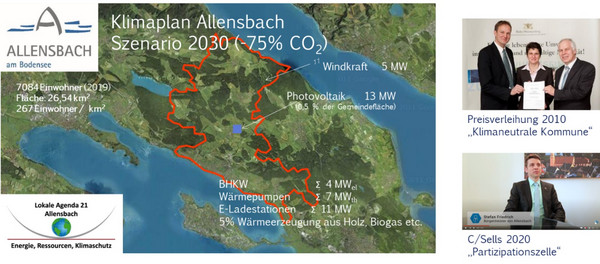
SoLAR Allensbach: a neighbourhood on Lake Constance as a model.
In a residential complex with 23 households, solar PV, a combined heat and power plant, heat pumps, charging points and household appliances were connected using our technology. Funded by the Baden-Württemberg Ministry of the Environment, 2018 to 2021.
Netzpuls · the simulator
Build your own power grid.
In the Netzpuls simulator you run a whole island village or an interconnected grid. You add solar, wind and storage and watch live as heat pumps and electric cars respond to the grid signal without any central control, and so optimise the system.
- Runs in the browser, nothing to install
- Tutorials explain the idea step by step
- Scenarios such as Island Village and Interconnected Grid 2025
News
From our projects and network
Easy Smart Grid – Winner @Urban Tech Hackathon
Combining needs with ideas creates innovation! With several other European innovation hubs, Cyberforum in Karlsruhe organized just that: “Challenge owners” formulated needs, “Solution owners” proposed ways to achieve …
20 Jun 2022SoLAR - bereit für 100% Erneuerbare
SoLAR zeigt im „Grünsten Wohnquartier am Bodensee“, wie in der zukünftigen Energiewelt das System „vom Kopf auf die Füße gestellt“ wird: Nicht große fossile Kraftwerke folgen einem vorgegebenen Bedarf, sondern viele …
16 Mar 2022Dependance on natural gas
Yesterday we heated our houses by burning gas (of which in Germany 55% came from Russia). Today we should use heat pumps instead – in new and existing buildings: They take ¾ of the energy from the environment and ¼ from …
Let us talk about the grid of tomorrow
Investment, pilot project or partnership: we look forward to hearing from you.