

Key Ideas

Simple, robust and affordable technology

Easy Smart Grid proposes a simple, robust and affordable technology to implement an efficient energy management in renewable energy dominated grid.

It combines two well-known principles that have been so far considered separately in the energy market: 

The economic principle: Production and consumption of electric energy units should have variable prices, and a market be created where at any time the appropriate balance will be established.

The engineering principle: Any imbalance of supply and demand leads to a shift of grid frequency. Nowadays, the deviation from the average frequency has been used to control output from centralized fossil plants. 
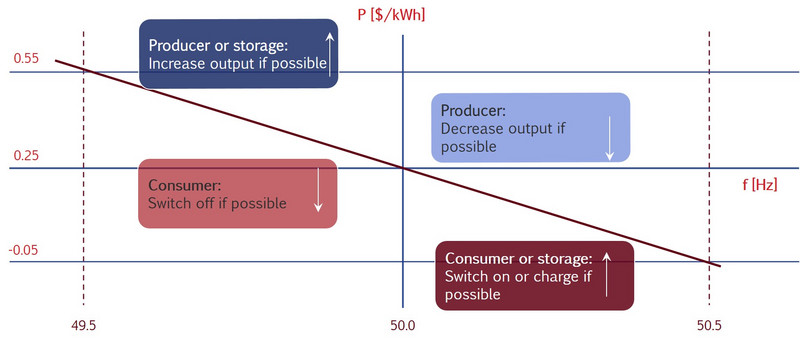
Easy Smart Grid combines these two principles where price signal are coded within the grid frequency, so that technical and economic stimuli work in synchronism. Based on economic criteria (energy price), all the grid participants take energy decisions in a similar way a technical scheme would. 

  • High energy price (low frequency) means:
    • short energy supply → reduce energy demand if possible
    • high energy demand →  increase energy production if possible
  • Low energy price (high frequency) means:
    • high energy supply → increase energy demand if possible
    • short energy demand → reduce energy production if possible

“Today, the penetration of renewables is no longer a question of technology or economics but one of developing more flexible markets and smarter energy systems. Thus, the policy focus should be on transforming power grids to become more flexible, increasing demand-side integration, and integrating power systems with transport, buildings, industry, and heating and cooling sectors, with the support of regulations, business, and finance models.” (REN21: Renewable 2014 – Global Status Report – Key Findings. 2014, p12.)


Easy Smart Grid technology empowers a new energy market where all the existing flexibility are leveraged and where every grid participants receive financial incentive to observe a grid supportive behavior.